

Trooping the Colour is a grand ceremonial event that celebrates the official birthday of the British monarch.
Held annually in June, this pageantry-rich tradition has deep historical roots, dating back to the 17th century when the “colours” or flags of regiments were paraded before soldiers as a rallying point in battle.
Today, the event serves as both a show of military precision and a public celebration of royal heritage, bringing together the British Army’s Household Division and the Royal Family in a vivid spectacle of tradition and loyalty.
The ceremony takes place on Horse Guards Parade in London, a broad ceremonial space near St. James’s Park.
The monarch, currently King Charles III, arrives in a carriage or on horseback, greeted by a salute from the assembled troops.
Once seated at the reviewing stand, the monarch watches the regiments perform highly synchronized drills, including the actual “trooping” or presentation of the regimental colour.
This particular flag represents the heart of the regiment and symbolizes its history, honours, and identity.
Spectators line the Mall and surrounding areas, often waving flags and dressed in festive attire.
Members of the Royal Family appear on horseback or in carriages, and their presence is closely watched by royal enthusiasts around the world.
The event also includes stirring music from military bands, lending a theatrical and patriotic ambiance to the proceedings.
At the heart of it all is the precision and pageantry of the soldiers, many of whom train extensively for this moment of national pride.
One of the most anticipated moments comes at the end of the ceremony, when the Royal Family gathers on the balcony of Buckingham Palace. From there, they watch a Royal Air Force flypast, a breathtaking display of aircraft soaring overhead in coordinated formation.
This balcony appearance also offers the public a rare and symbolic glimpse of the monarchy’s unity, with senior and sometimes extended family members waving to the crowds below.
Trooping the Colour is more than a military parade; it’s a vibrant expression of national identity and continuity. It ties the present-day monarchy to centuries of British tradition and evokes a sense of unity through shared heritage.
For those who attend or watch the broadcast from afar, the event stands as a colourful reaffirmation of the monarchy’s role in public life and the enduring pageantry that defines the United Kingdom’s ceremonial traditions.
Talk of royalty, here is one!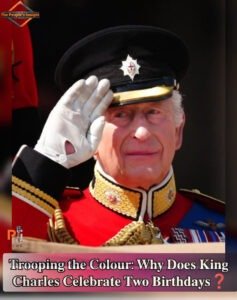
About the Author