Mojtaba Khamenei is Iran’s new supreme leader, having succeeded his father, Ayatollah Ali Khamenei, following the latter’s assassination in the first wave of joint US-Israel attacks on the Islamic Republic.
The 56-year-old younger Khamenei was announced as his father’s successor on Sunday after a vote by the assembly of experts, a group of clerics responsible for the appointment of Iran’s highest authority.
This makes him the country’s third supreme leader, after his father and Ayatollah Ruhollah Khomeini.
It is also the first time in the Islamic Republic’s history that a son directly succeeds his father in this role.
Prior to the 1979 Islamic revolution, which established the position of supreme leader as the cornerstone of Iran’s theocratic system, the country was ruled by the Pahlavi dynasty.
In Iran, the supreme leader has the final say in all matters of state, above the president.
The leader is chosen by an assembly of experts, an 88-member body, directly elected by the people and composed primarily of senior clerics.
How did Mojtaba Khamenei rise to clinch the most influential position in the country? This is everything we know about him.
THE CLERIC STEPPING OUT OF HIS FATHER’S SHADOW
Perhaps the most interesting and contradictory fact about the younger Khamenei is the little public knowledge about him owed to his largely secretive life.
Born on September 8, 1969, the cleric previously operated behind the scenes as a key power broker.
Khamenei had always enjoyed high popularity among rank-and-file Islamists because he was so close to his father and assumed a leadership role of deputy chief of staff for political and security affairs in his office while the ayatollah was alive.
Khamenei has never held government office but was described as a gatekeeper to his father. He was the ayatollah’s second-oldest son.
Though state and international media often touted him as a likely successor, it was assumed that grievances, including a deteriorating economy, a repressive domestic policy, and foreign policy goals that saw many losses towards the end of his father’s regime, could work against him.
He studied under religious conservatives in seminaries in the city of Qom and is described as a hardliner with close ties to the Islamic Revolutionary Guard Corps (IRGC), where he served in the Habib Battalion during the Iran-Iraq War.
SANCTIONED BY THE US
In 2019, the US sanctioned Khamenei, alongside his father and close associates, for having “oppressed the Iranian people, exported terrorism, and advanced destabilizing policies around the world” over decades.
Khamenei was sanctioned for representing his father in an official capacity despite never being elected or appointed to a government position aside from work in the ayatollah’s office.
According to the US, Khamenei worked closely with the IRGC Qods Force and also the Basij Resistance Force (Basij) to advance his father’s “destabilising regional ambitions and oppressive domestic objectives”.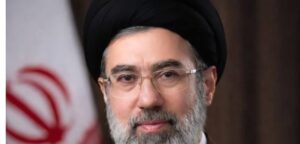
About the Author