

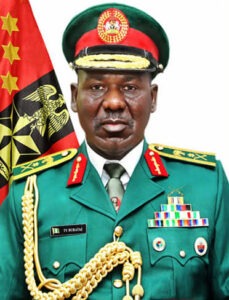
Former Chief of Army Staff, Lt. Gen. Tukur Yusuf Buratai (Rtd.), has stirred national debate with his recent proposal that Nigeria should adopt a COVID-19-style lockdown as a strategy to decisively combat terrorism, banditry, and kidnapping.
According to Buratai, the rising wave of insecurity demands extraordinary measures that go beyond conventional military operations. He argued that just as Nigeria imposed a strict lockdown during the pandemic to contain the spread of the virus, a similar nationwide restriction could help security agencies flush out criminal elements hiding within communities.
“The same urgency and coordinated response that were deployed during COVID-19 can be replicated to deal with the threats of terrorism and banditry. It will require sacrifice, but the long-term benefit is a safer and more stable Nigeria,” he reportedly stated.
Why a Lockdown?
Buratai explained that terrorists, bandits, and kidnappers thrive because of freedom of movement, porous borders, and weak surveillance. A temporary nationwide lockdown, he suggested, would disrupt their networks, cut off supply chains, and allow security forces to systematically identify and neutralize them.
Possible Benefits and Challenges
While the proposal has attracted interest, security analysts point out that such a measure could:
1 Strengthen military operations by limiting civilian movement and making it easier to isolate criminals.
2. Facilitate intelligence gathering as unusual movements during lockdowns would be easier to detect.
3. Boost public confidence if well executed, proving that government is serious about ending insecurity.
However, critics warn that a lockdown could:
Deepen economic hardship for millions of Nigerians who rely on daily income.
Trigger human rights concerns, particularly if abused by security forces.
Require massive government support systems to prevent hunger and unrest during the period.
National Conversation
Buratai’s proposal has already sparked mixed reactions among citizens and policymakers. Supporters see it as a bold, innovative approach, while skeptics argue that Nigeria’s fragile economy and governance structure may not withstand another large-scale lockdown.
As insecurity remains one of Nigeria’s greatest challenges, the suggestion has once again brought to the fore the urgency of finding lasting and unconventional solutions to restore peace and stability.
About the Author