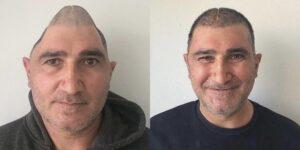
Doctors in Istanbul have rebuilt 83 percent of a man’s skull using 3D printing technology and titanium implants. The patient, Ali Çiftçi, is now living a normal life again after doctors said he had only a small chance of survival.
Ali, a 45-year-old father of two, faced tragedy on what was supposed to be a special day. On his birthday, a thief broke into his home. During a fight with the burglar, both men fell from the third-floor window. Ali landed first, and the thief landed on top of him. The fall crushed most of Ali’s skull. The burglar escaped unharmed.
I served as an airbag for the thief,” Ali said as he remembered the night. “Since I was at the bottom, he fell on top of me. Nothing happened to him. He just climbed the wall and escaped by stepping on me. The incident remains unsolved, and unfortunately, the burglar has not been found.”
Ali’s injuries were life-threatening. He spent almost six months in intensive care and went through many surgeries for more than two years. Doctors told his family there was only a ten percent chance of survival. Still, he kept fighting.
“When I went to the hospital, the doctors would say, ‘The miracle worker has arrived,’” Ali recalled. “I couldn’t properly understand what was happening because I was in so much pain. I was always dizzy, my vision would go black, and I walked on the far side of the road so if I fainted, cars would not hit me.”
Life during those years was extremely hard. With most of his skull missing, Ali lived with pain, confusion, and the shame of his appearance. He often wore a hat to protect himself from infection, but people in the streets would stare and laugh.
“I used to always wear a hat to avoid getting infected, and when I went out, people would always laugh and say, ‘Look at that,’” he explained. “Before, people would look at me strangely, saying, ‘What’s this guy’s head like?’ Thank God, I’m healthy again.”
Everything changed when Ali was admitted to the Health Sciences University (SBU) Gülhane Training and Research Hospital. There, doctors and engineers at the Medical Design and Production Center (METÜM) created a plan to rebuild his skull with 3D-printed titanium implants.
Prof. Dr. Özkan Tehli, from the Department of Brain and Neurosurgery, explained the extent of the damage. “When Ali arrived at our hospital, we saw that 64 percent of his skull’s surface area and 83 percent of its volume were missing. He had balance problems, memory loss, difficulty walking, and vision problems. After the surgery, we observed that his complaints decreased by around 90 percent.”
The titanium implants were custom-made for Ali’s head. Engineers used his scans to create a 3D digital model. This model was then printed and shaped to match the missing parts of his skull. After approval from the doctors, the implants were placed into his head through surgery.
Prof. Dr. Simel Ayyıldız, Director of METÜM, explained the method. “After the patient’s information and scans reach our center, we create a 3D model of the missing area. This allows doctors to see the loss before surgery. Then, our engineers design titanium implants with specialized software. After the models are approved, they are manufactured and surgically placed in the patient.”
Ali’s transformation was not just physical but also emotional. After the surgery, his head returned to its natural shape, and his health improved. He regained his confidence and returned to work. “I’m now working as diligently as I used to. My employers are happy with this, and so am I. I’m doing my best, working overtime on weekends. In other words, the person who was said to have died is now working,” he said.
The surgery not only gave him back his appearance but also restored his brain functions. Doctors say the surgery is important not only for how patients look but also for their neurological health, as it improves blood circulation and brain fluid flow.
Today, Ali no longer hides under a hat or fears strange looks. Instead, he carries a story of hope. “All of that is behind me now,” he said with relief. “I’m fine, my head is back to its original shape, and I’m healthy again.”
About the Author