

Delta State Governor Sheriff Oborevwori has appealed to President Bola Tinubu to approve Delta State as the location for the headquarters of the newly created 83 Division of the Nigerian Army.
Oborevwori made the appeal when he received a delegation from the Nigerian Army Headquarters during a stakeholders’ consultative visit to Asaba on the realignment of Areas of Responsibility following the creation of the new division.
The delegation was led by the Chief of Army Standards and Evaluation, Major-General Thompson Bobby Ugiagbe.
The governor argued that Delta was strategically positioned to host the division headquarters because of its central location among Delta, Edo and Bayelsa states, as well as the concentration of critical oil and gas infrastructure in the state.
According to him, locating the headquarters in Delta would improve the Army’s response time and strengthen the protection of strategic national assets across the South-South region.
“Delta State is more central. Somebody coming from Edo will come through Delta, while somebody from Bayelsa to Edo will also pass through Delta. If the headquarters is located here, everybody can connect to the centre,” Oborevwori said.
He noted that Delta contributes significantly to Nigeria’s oil and gas production and has several strategic assets requiring adequate security.
The governor also highlighted the presence of three airports in Asaba, Osubi and Escravos, as well as seaports in Warri, Burutu, Sapele and Koko.
“These are critical assets that require security,” he said.
Oborevwori appealed to the committee to recommend Delta to the Chief of Army Staff and President Tinubu as the headquarters location, assuring that the state was prepared to support the establishment of the formation.
He said the state government was willing to provide land and temporary facilities and contribute financially to ensure the effective take-off of the new formations.
“This is not a passive appeal for the constitution of the division. It is a request for partnership from a state that understands what is at stake,” the governor said.
Oborevwori recalled that his administration had previously provided land and infrastructure support for military formations established in the state, promising continued cooperation with the Nigerian Army.
He also pointed to Delta’s large number of retired senior military officers, including retired four-star generals, arguing that locating the headquarters in the state would recognise their contributions to national service.
Earlier, Ugiagbe conveyed the goodwill of the Chief of Army Staff and thanked the governor and people of Delta for their support for the Nigerian Army.
He explained that the creation of the 83 Division followed President Tinubu’s approval for the expansion of the Nigerian Army from eight to 12 divisions.
According to him, the new division will have responsibility for Delta, Edo and Bayelsa states, while the restructuring will also lead to the establishment of additional military units to strengthen security coverage.
Ugiagbe said Delta would retain the 63 Brigade headquarters in Asaba, three battalions in Warri, the 90 Amphibious Battalion and the 181 Battalion.
The state is also expected to receive three additional formations: the 246 Recce Battalion already established in Oleh, a new Field Artillery Regiment and an Air Defence Regiment.
He said the additional formations were necessary because of Delta’s strategic importance and the need to strengthen the Army’s presence across the state.
According to Ugiagbe, the Field Artillery Regiment is proposed to be located close to the brigade headquarters, while the Air Defence Regiment is proposed for Osubi because of its strategic importance and proximity to critical infrastructure, including the airport.
“The Air Defence Regiment provides a large coverage for critical assets like airports, refineries and other critical national infrastructure,” he said.
The Army delegation also sought the state government’s assistance with temporary facilities and land to enable the new formations to commence operations pending the development of permanent infrastructure.
Ugiagbe said the Army would work with relevant state agencies, including mapping and geographical information authorities, to identify and document the land required for the new formations.
He stressed that the deployment strategy was designed to ensure wider geographical coverage and reduce response time to security threats across the division’s area of responsibility.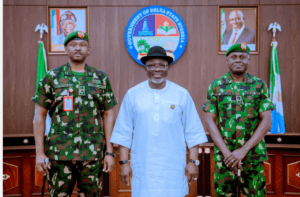
About the Author