


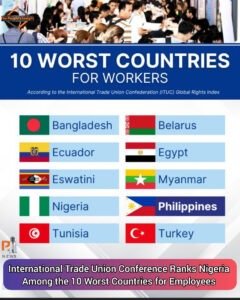
 Nigeria has secured a position in the International Trade Union Conference’s ranking of the 10 worst countries for workers in 2025.
The International Trade Union Confederation (ITUC), according to its latest Global Rights Index released during the 113th session of the International Labour Conference (ILC) in Geneva, Switzerland, noted that Nigeria, as well as other countries like Bangladesh, Belarus, Ecuador, Egypt, Eswatini, Myanmar, the Philippines, Tunisia, and Türkiye, are the worst countries for workers.
The body assesses countries based on their respect for collective labour rights, with a maximum focus on violations of internationally recognized labour standards by both governments and employers.
The report was unveiled in Room 19 of the World Diplomatic Building, where delegates from 187 countries convened to discuss global labour challenges.
This year’s conference is centred on establishing potential new international standards to protect workers from biological hazards, promoting decent work in the platform economy, and advancing strategies to support the shift from informal to formal employment.
Notably, this marks the first time Nigeria has appeared among the 10 worst countries for workers since the index began in 2014.
The report stated as follows:
“Africa recorded its second-worst reading on record, deteriorating to 3.95 from 3.88 in 2024. These figures suggest that workers across the region endure systematic violations of their rights.
“The rights to strike, collective bargaining, and to form or join a union were impeded in 90% of countries. Nigeria entered the top 10 worst countries for the first time.
“Most workers, employed in the informal sector, have no labour protection. The rights to strike, to collective bargaining, and to establish or join a trade union are violated in 93% of countries. While fewer countries reported violence against workers, union activists were killed in Cameroon and South Africa.
“Strikes and protests were met with violent suppression in Cameroon, Kenya, Mauritania, and South Africa. Employers sabotaged union activity in Botswana, Ethiopia, Guinea, Kenya, Lesotho, Liberia, and Senegal.
“In Nigeria, a new entry to the 10 worst countries in the world for working people, Eswatini, and Zimbabwe, trade unionists faced repression for their activities, while authorities in Eswatini, Guinea-Bissau and Zimbabwe banned protests and assembly.
“Military juntas in West Africa, including Burkina Faso, Chad, Gabon and Mali – prevented unions from operating freely. Conflicts in South Sudan and Sudan have left millions in desperate need of aid and severely threatened the livelihoods of workers.”
About the Author