
The Federal Government has moved to reinforce security around critical infrastructure in Abuja and neighbouring Niger State following intelligence reports of planned terrorist attacks.
Security agencies, including the Nigeria Police Force, Nigeria Immigration Service and Nigerian Correctional Service, confirmed on Thursday that measures have been strengthened at airports and custodial centres.
The action follows an internal memo by the Nigeria Customs Service which warned of plans by Islamic State West Africa Province, Boko Haram, Ansaru and JNIM to attack the Nnamdi Azikiwe International Airport, Kuje Custodial Centre and a military detention facility in Wawa, Niger State.
The document indicated that ISWAP fighters had already infiltrated parts of the Federal Capital Territory in preparation for coordinated attacks, with a possible objective of freeing detained insurgents.
In response, the Customs Service directed heightened surveillance around key locations, stricter screening of visitors and deployment of specialised intelligence units to vulnerable points.
Spokesperson for the Airport Police Command, Adeola Muhammed, said security operatives remain fully alert and prepared to respond to any threat.
“The command is always aware of potential security threats, and we are prepared to scale up measures as the situation demands. Whether you are entering or exiting the airport, you will be thoroughly screened,” he said.
He added that collaboration among security agencies has strengthened intelligence gathering and response capacity.
“There is effective collaboration between all security agencies when it comes to intelligence sharing, and as a result, the command is, and will always remain a step ahead of any threat,” Muhammed stated.
The Nigeria Immigration Service also confirmed it had intensified security across its facilities in the FCT.
“We are sure the police are handling this threat already, and a section of the army too,” said its spokesperson, Akinsola Akinlabi.
“The one that has to do with Corrections, they are taking close measures at their facilities,” he added.
On its part, the Nigerian Correctional Service assured Nigerians that all custodial centres have been placed on high alert.
“We want to assure Nigerians that our facilities in Abuja and other states are on high alert. We have taken proactive steps. We also want to assure Nigerians not to panic; they should go about their lawful activities without fear or apprehension,” said spokesperson Jane Osuji.
Security analyst Chidi Omeje warned that authorities must act decisively on intelligence to prevent a repeat of past failures.
“The very clear thing the government should do is to take it seriously, to take intelligence reports seriously. We’ve had such experiences before where warnings were detailed, yet the predictions came to pass,” he said.
Another expert, Lekan Jackson-Ojo, criticised what he described as weak responses to intelligence alerts in the past.
“Over time, we have seen cases where intelligence reports were received, but the response was ineffective. In some instances, security personnel were deployed briefly and withdrawn before any attack occurred, leaving communities exposed,” he said.
He also cautioned against concentrating security efforts only in Abuja, warning that other vulnerable states must not be neglected.
“They must beef up security in the FCT, but not at the detriment of other states like Niger, Sokoto, and Zamfara. If all attention is shifted to Abuja, it creates loopholes elsewhere, which these groups can exploit,” he added.
Meanwhile, the military said no fewer than 744 former insurgents and victims of violent extremism have graduated from the Federal Government’s de-radicalisation programme under Operation Safe Corridor.
Chief of Defence Staff, Olufemi Oluyede, described the initiative as a strategic effort to reduce violence and promote long-term stability.
“This moment is not just a ceremony; it is a statement of progress, a demonstration of national resolve and a testimony to the power of strategic thinking in addressing human dimensions of conflict,” he said.
He added, “Operation Safe Corridor represents Nigeria’s firm belief that while kinetic operations are necessary to neutralise threats, lasting peace can only be achieved when we address the underlying drivers of de-radicalisation, disengagement and reintegration.”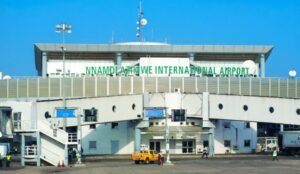
About the Author