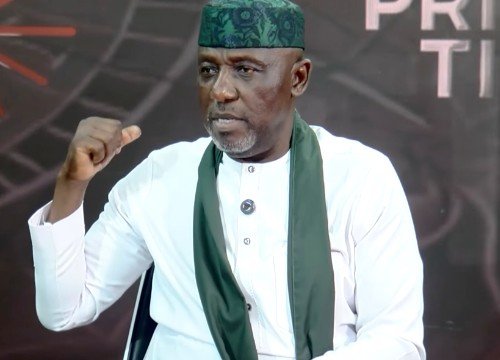
Senator Adams Oshiomhole has defended the Federal Government’s proposed external borrowing plan, insisting that borrowing is not inherently wrong but should be assessed based on how the funds would be utilised.
The senator representing Edo North Senatorial District said governments across the world borrow to finance development, stressing that loans invested in productive infrastructure could stimulate economic growth and generate revenue to support repayment.
Oshiomhole made the remarks during an interview on ARISE News on Friday while reacting to President Bola Tinubu’s request for legislative approval to secure fresh external loans worth $20.52bn and €1.045bn.
The proposed borrowing, which is intended to finance infrastructure and other development projects, has attracted public concerns over Nigeria’s rising debt profile and the absence of detailed information about the projects to be funded.
Speaking on the controversy, the former Edo State governor maintained that sustainable economic growth would be difficult to achieve without adequate infrastructure.
He, however, acknowledged concerns about the need for transparency, explaining that the Senate was yet to conclude its examination of the borrowing proposal.
According to him, the request had been referred to the Senate Committee on Local and Foreign Debts for scrutiny, after which the findings would be presented to the plenary for further deliberation.
Oshiomhole said the committee would examine the purpose of the proposed loans and engage with the Ministry of Finance to obtain further details about their intended utilisation.
He said lawmakers would have the opportunity to debate the proposal after the committee had completed its review.
The senator added that he could not provide further details about the proposed projects until the relevant committee had completed its examination of the request.
Defending the government’s decision to borrow, Oshiomhole argued that the major concern should be whether the funds would be invested in projects capable of delivering economic benefits.
He explained that borrowing to finance recurrent expenditure, such as feeding, could amount to waste, whereas investing in infrastructure and productive assets could create opportunities to generate income and repay the loans.
He said, “But in principle, I believe that every country borrows. And the real issue is borrowing to do what? If you are borrowing to feed, many will say, myself inclusive, that that would be wasteful.
“If you borrow to build a house and people can see the building, then that is not wasteful because in paying back, the building will be able to generate income on its own.
“So I think we should be speaking more about borrowing to do what? It is that what we need to speak to, not the fact of borrowing. There is nothing strange in it.”
Oshiomhole also noted that government borrowing was increasing across major economies, including the United Kingdom and the United States, arguing that Nigeria was not alone in relying on loans to finance its activities.
He maintained that the focus should remain on the objectives of the borrowing, rather than treating the decision to obtain loans as a problem in itself.

About the Author