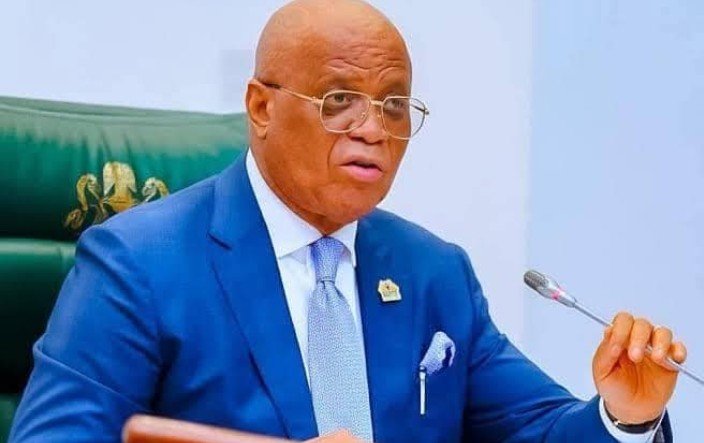
Senate President Godswill Akpabio has urged northern youths to intensify grassroots mobilisation for President Bola Tinubu’s re-election in 2027, alleging that some people criticising the President and his supporters on social media are being paid.
Akpabio made the remarks on Wednesday in Abuja when members of the Arewa Revival Project, a youth organisation with members across the 19 northern states, visited him and presented him with an award for his contributions to nation-building.
The Senate President urged the group, led by its coordinator, Mustafa Ibrahim, to engage young people at the grassroots and explain what he described as the benefits of continuity in government.
He acknowledged the challenges of countering online criticism but urged the youths to organise periodic gatherings to educate Nigerians about the administration’s policies.
“Most of those who are attacking the President and attacking these young men on social media are being paid. You are not being paid,” he said.
Akpabio advised the group to focus on direct engagement with communities rather than attempting to compete with critics on social media.
He also defended Tinubu’s economic policies, including the tax reforms, arguing that the administration was working to diversify the economy away from its dependence on crude oil.
According to him, the government has introduced reforms aimed at addressing longstanding structural challenges and improving the country’s economic prospects.
Akpabio further declared that members of the National Assembly had endorsed Tinubu for a second term, expressing confidence in the President’s performance and urging Nigerians to give his policies time to produce results.
The President is expected to seek re-election in 2027 amid growing political activities and preparations by opposition parties to challenge the ruling All Progressives Congress.
On security, Akpabio expressed optimism that Nigeria would soon establish state police, claiming that about 30 State Houses of Assembly had endorsed the proposed constitutional amendment to introduce decentralised policing.
He said the constitutional amendment process was nearing completion and expressed hope that state police would strengthen the country’s response to insecurity by bringing policing closer to local communities.
The proposed reform is part of broader efforts to decentralise Nigeria’s policing system, with supporters arguing that state-controlled police structures could improve responses to local security threats.
Akpabio also urged the youths to remain optimistic about Nigeria’s future, expressing confidence that the country would overcome its security challenges.
Earlier, Ibrahim said the group considered the Senate President deserving of the award because of his contributions to national development and the achievements of the National Assembly under his leadership.
About the Author