

Former President Goodluck Jonathan has urged the Federal Government to revive the Almajiri education programme and the Great Green Wall Project, warning that addressing youth unemployment and social challenges is essential to tackling terrorism and other forms of insecurity in Nigeria.
Jonathan said the initiatives introduced during his administration were designed to provide young people with educational and economic opportunities while reducing their vulnerability to recruitment by extremist groups.
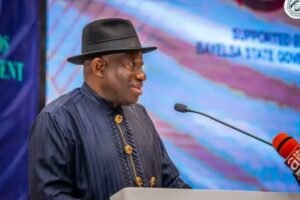
He made the call on Saturday in Abuja at the public presentation of Beyond the Bullets: Policing Terrorism in a Democratic System, a book authored by former Inspector-General of Police, Mohammed Dikko Abubakar.
Represented by his former Chief of Staff, Mike Oghiadomhe, Jonathan said his administration established at least 121 Almajiri schools across northern Nigeria to provide children with skills and education beyond religious instruction.
According to him, the programme was intended to equip young people with practical and technical skills that would enable them to earn a living, contribute to national development and resist recruitment into violent criminal activities.
He expressed concern over the decline of the initiative, noting that successive administrations had failed to sustain the programme’s original objectives.
Jonathan stressed that the fight against terrorism required continuity, cooperation and sustained commitment from successive governments rather than reliance on military operations alone.
He said, “The fight against terrorism is not the responsibility of one administration or another. It is a continuing national and global challenge that requires sustained commitment, institutional learning and co-operation across successive governments and generations.”
The former president also highlighted the Great Green Wall Project, which was designed to combat desertification, restore degraded land and create employment opportunities through agriculture and livestock production.
He said the initiative had the potential to make more land available for farming and animal husbandry while providing jobs for hundreds of thousands of Nigerians.
Jonathan urged the government to reassess both programmes and explore ways to restore their effectiveness in addressing insecurity, unemployment and other socio-economic challenges.
Meanwhile, former Senate President Bukola Saraki called on Nigerians to recognise that the responsibility for tackling insurgency and violent extremism should not be left solely to the military and police.
Saraki praised Abubakar’s professional record, recalling his efforts to retain the former police chief as Commissioner of Police in Kwara State because of his contribution to peace and security during his tenure as governor.
Also speaking at the event, Inspector-General of Police Olatunji Disu said effective policing depended not only on the use of force but also on strong values, respect for the rule of law and public trust.
Disu described the book as a valuable resource for policymakers, security professionals, scholars and members of the public seeking to understand the challenges and responsibilities of police leadership.
The book’s chief launcher, Aliko Dangote, commended Abubakar for his contributions to Nigeria’s fight against terrorism.
In his remarks, Abubakar urged the military and other security agencies to remain professional in carrying out their constitutional responsibilities. He warned officers against adopting the same abusive practices they were trained to prevent, stressing the importance of accountability and discipline in security operations.
About the Author
