
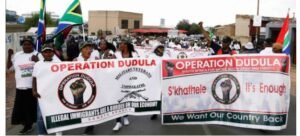
In a now-viral video circulating across social media platforms, Dabula announced the group’s intention to launch a campaign in late December 2025 and early January 2026, targeting public schools across the country to block non-South African children from enrollment.
“We’re going to launch a campaign at the end of December, the first week of January 2026. We’re going to be stationed at schools, and no foreign child will be attending school in a public school,” Dabula said.
She further stated that the group’s actions would not extend to private institutions, saying, “They can rather take them to private [schools], we don’t care, but at public schools it’s going to be reserved for South African children only.”
Xenophobic Roots and History of Violence
Dabula’s comments reflect Operation Dudula’s long-standing anti-immigration agenda, which has included violent xenophobic campaigns targeting African migrants, particularly those from Zimbabwe, Mozambique, Malawi, and Nigeria.
She claimed that some foreign children are in the country illegally and alleged that many who appear to have legal documentation may be using fraudulent papers.
“So I’m talking about illegal foreigners who will definitely not be accepted. But those who claim to be legal, we have home affairs, bogus home affairs and we’ve seen a lot of them. You too, you also know about these bogus home affairs,” she stated.
“They must be checked, thoroughly checked, because how did they come to this country? Are their parents documented? But they will be last in the queue,” she added.
Dabula justified the group’s planned action by citing what she described as limited national resources, invoking South Africa’s constitution to defend the exclusionary stance.
She said, “Section 27(2) says that if there are available resources, then we can share with other people, but currently we don’t have; we are short of resources.
“So foreign children will be last in the queue and then South Africans first, and then once all South Africans are admitted, then we will start admitting them. Those are only the children that are legally in this country.”
Videos online also show members of the group blocking immigrants and foreigners from accessing medical facilities in the country earlier this month.
Members of the movement have also targeted public buildings they claim have been ‘hijacked’ by foreigners at the expense of South Africans, pushing for the eviction of such occupants.
A South African resident, Crispin Hemson, narrated his experience in a post shared on Facebook.
Police Inaction and Public Concern
Hemson’s message sounded the alarm over what he described as the creeping rise of fascism in South Africa after witnessing members of the anti-immigrant group openly blocking access to a public hospital and targeting foreign nationals seeking medical care.
Hemson, an academic and activist, shared his disturbing experience in a Facebook post after visiting Addington Hospital in Durban, KwaZulu-Natal, where he encountered unidentified individuals demanding IDs from patients at the hospital entrance and denying access to anyone suspected of being foreign.
Hemson debunked the group’s legal justification, noting that Section 17 of South Africa’s Constitution refers to the right to peaceful protest, not gatekeeping access to hospitals. In contrast, Section 27 enshrines the right to healthcare for “everyone”, regardless of nationality, he also said.
Hemson wrote: “Today I had to go to a department at Addington Hospital. It was an introduction to an emerging form of fascism in South Africa. Unidentified people are blocking the entrance and requiring people to show their IDs. Of course, I was not going to do that, but I could see other people complying.
“These people clearly stated that they were stopping foreigners from accessing healthcare at the hospital – they claim to be enforcing Section 17 of the Constitution.
“This is complete nonsense; Section 17 is about the right to peaceful protest. Section 27, however, states that ‘Everyone has the right to have access to healthcare services.’ This group thus directly broke the basic law of the country.
“I was suitably obnoxious and told them clearly that they are lying to people and that they are loyal to Apartheid. This accusation they really loyal to Apartheid. This accusation they really did not like. I asked for the name of the one person and he said I had no right to ask it. He told me that I was not allowed to record him on video in terms of the POPI Act (nonsense; this is a public area).
“Somewhat worse still, the security guard at the entrance, employed by Nobantu Guarding, told me that these people are doing their work, and that foreigners are not allowed in.
“Fortunately, I was able to speak briefly to the hospital manager, who at least confirmed that the security guard was out of line.
“I went to the local police station to complain about it. The officer I spoke to said, ‘Well, they have doing this all week. It’s political.’ Which meant that the police don’t get involved. As I pointed out to him, there is an uproar raging about politicians interfering with law enforcement at present in South Africa; his job is the law, not politics.
“When I returned to the scene after I left the department, I noticed that there were other people anxious about the situation and hanging back. A woman of Indian background was speaking to a car guard saying she was not sure about going in.
“I am middle-class and pushy; for working class people this can be a tense situation that deters them from getting access to healthcare. Remember that, in each violent xenophobic event in the province, some of those killed were South Africans wrongly thought to be foreign.”
About the Author