

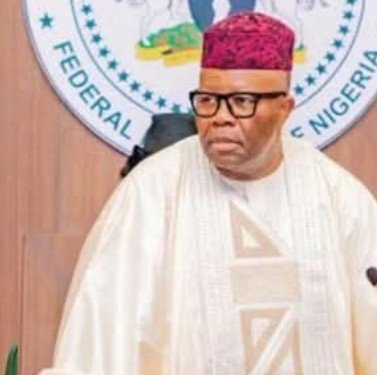



Minister of Power, Joseph Tegbe, has revealed that some Nigerians have asked him to “slow down” with efforts to improve electricity supply because their freezers are now working continuously.
Tegbe made the disclosure on Wednesday in Abuja while speaking at the commissioning of a 3-megawatt solar hybrid power project at Yakubu Gowon University, formerly known as the University of Abuja.
According to the minister, some areas that previously experienced prolonged power outages are now receiving up to 18 hours of electricity daily.
“Places that didn’t have light at all for three months are now having 18 hours light. Some areas called me to say, look, I should slow down, that everything in their freezer is freezing. That is what freezer is meant to do. Let it freeze the food that needs to be frozen,” Tegbe said.
The minister recalled that during his Senate screening, he promised that Nigerians would begin to notice improvements in electricity supply within three to six months.
He, however, acknowledged the challenges confronting the power sector, noting that some electricity infrastructure across the country is more than 40 years old.
“Some of the infrastructure we have in the electricity and power sector are more than 40 years old. We’re systematically replacing them, phasing them out and bringing new ones,” he said.
Tegbe also raised concerns over the vandalism of critical electricity infrastructure, revealing that three major transmission towers in Birnin Kebbi had been brought down by vandals.
He said the affected towers were part of the infrastructure supplying electricity to Kebbi State and extending to Niger Republic.
According to him, the vandals attacked the foundations of the towers before bringing them down and cutting parts of the structures for sale as scrap.
The minister disclosed that the Federal Government had established a joint working committee involving the Economic and Financial Crimes Commission, the Nigeria Police Force and the Nigeria Security and Civil Defence Corps to monitor and protect national electricity assets.
“You will not believe how many towers get pulled down by vandals,” he said.
Tegbe added that the government was working to ensure that vandalism of critical electricity infrastructure was treated as a serious criminal offence.
Speaking on the Yakubu Gowon University project, the minister said the facility comprises a 3.3-megawatt solar array, 3MW AC output capacity and battery storage designed to provide electricity to critical university facilities.
The project is expected to power lecture halls, laboratories, ICT facilities, administrative buildings, campus lighting and other essential services.
Tegbe said more than 58,726 students were expected to benefit from the project, which includes 6,078 photovoltaic panels and 388 streetlights installed across the university.
He added that the project created 3,201 jobs during its implementation.
The minister said the battery storage capacity could be expanded to extend electricity supply to other parts of the university, including student hostels.
He also said the Rural Electrification Agency would work with the university to address areas of the campus that still required improved lighting.
Tegbe urged the university to use the facility as a platform for research into renewable energy, battery storage, smart metering, energy management, grid integration, cybersecurity and other areas of modern energy technology.
The Managing Director of the Rural Electrification Agency, Abba Abubakar Aliyu, described the project as a significant milestone under the Federal Government’s Energising Education Programme.
Aliyu said the value of the programme should not be measured only by the amount of electricity generated but also by its impact on students, academic activities, research and the overall learning environment.
He said reliable electricity would enable laboratories to operate more effectively, strengthen digital services and reduce pressure on university operating costs.
Also speaking, the Head of the Nigeria Electrification Project, Olufemi Akinyelure, said the significance of the project extended beyond electricity generation because reliable power could create wider development opportunities.
He said powering universities would help promote innovation, research and skills development.
Chairman of the Senate Committee on Power, Senator Enyinnaya Abaribe, commended the Federal Government and the minister for implementing the Energising Education Programme.
Abaribe said reliable electricity was fundamental to the development of Nigeria’s education system, while stressing that communities must also play an active role in protecting public infrastructure.
Earlier, the Vice-Chancellor of Yakubu Gowon University, Prof. Hakeem Fawehinmi, said dependable electricity was critical to the institution’s academic mission.
Fawehinmi said a modern university could not effectively teach, conduct research, operate laboratories or sustain digital services without reliable power.
He expressed appreciation to the Federal Government and the Rural Electrification Agency for the intervention, describing the solar hybrid project as a major infrastructure investment in the university.
He also called for continued collaboration between government agencies and the university to ensure that the project remains operational and delivers its intended benefits to students and staff.
About the Author